Many business owners see accounting as a yearly obligation focused on tax returns, financial statements, and compliance requirements. While these services are essential, modern businesses often need more than traditional compliance accounting. They need guidance that helps them make better financial decisions, improve profitability, manage risks, and plan for growth. This is where a strategic accountant Adelaide can make a significant difference.
The difference between a compliance accountant and a strategic accounting partner is not just about preparing numbers. It is about how those numbers are used. A compliance accountant focuses on meeting legal requirements, while a strategic accounting partner works alongside business owners to create financial strategies that support long-term success.
For small businesses, choosing the right financial support can influence cash flow, tax outcomes, and future opportunities. Understanding the difference between accounting and advisory helps business owners determine whether they need only record-keeping support or a proactive partner to guide business decisions.
Quick Answer: Compliance Accountant vs Strategic Accounting Partner
A compliance accountant mainly focuses on fulfilling government and regulatory obligations, including tax returns, bookkeeping, and financial reporting. Their role is essential for maintaining accurate records and avoiding penalties.
A strategic accounting partner goes beyond compliance by analysing financial data, identifying opportunities, improving business performance, and providing forward-looking advice.
| Compliance Accountant | Strategic Accounting Partner |
|---|---|
| Focuses on tax and reporting requirements | Focuses on business growth and financial strategy |
| Works mainly with historical data | Uses current data to plan future outcomes |
| Provides annual accounting services | Provides ongoing financial guidance |
| Ensures compliance obligations are completed | Helps improve profitability and decision-making |
| Reactive approach | Proactive approach |
Businesses that only need basic reporting may benefit from compliance services. However, businesses looking to grow often require the support of a strategic accountant who understands their goals.
What Does a Compliance Accountant Do?
A compliance accountant helps businesses maintain accurate financial records and meet required legal obligations. Their primary responsibility is ensuring that financial information is correctly prepared and submitted according to Australian taxation and reporting standards.
Traditional accounting services usually include:
- Preparing annual financial statements
- Managing tax returns and GST obligations
- Reviewing bookkeeping records
- Ensuring payroll compliance
- Maintaining accurate financial documentation
- Supporting audit and reporting requirements
For many businesses, especially those in the early stages, compliance accounting provides a strong foundation. Having accurate records allows owners to understand their current financial position and remain compliant with regulations.
However, compliance-focused accounting generally looks backward. It explains what happened financially but may not always provide guidance on what actions should be taken next.
What Is a Strategic Accounting Partner?
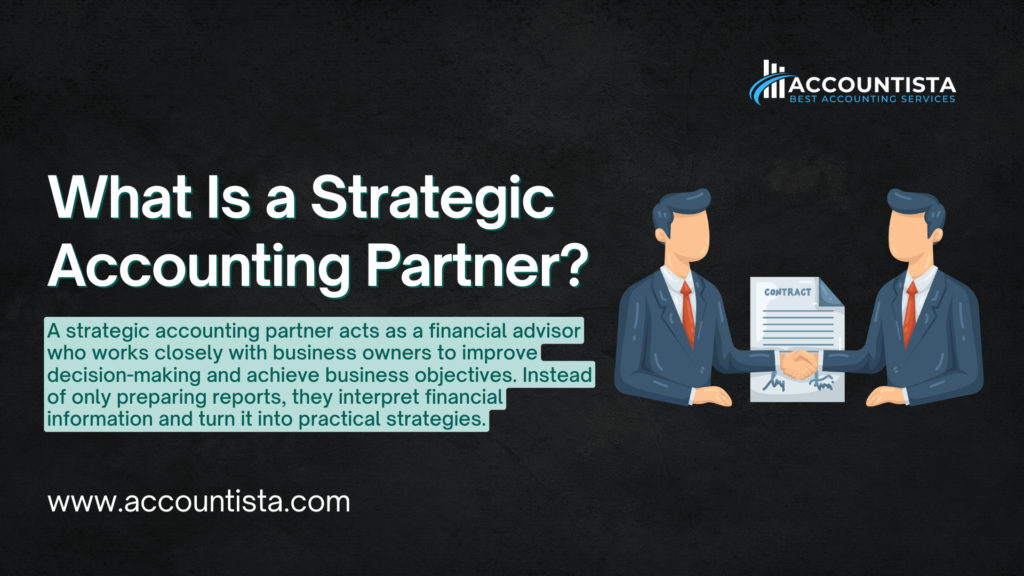
A strategic accounting partner acts as a financial advisor who works closely with business owners to improve decision-making and achieve business objectives. Instead of only preparing reports, they interpret financial information and turn it into practical strategies.
A strategic accountant Adelaide helps businesses understand:
- Where profits are being generated
- How expenses can be controlled
- How cash flow can be improved
- When to invest or expand
- How tax planning opportunities can be maximised
The relationship is based on collaboration rather than simple service delivery. A strategic accounting partner becomes involved in important business conversations, helping owners make decisions with confidence.
For growing businesses, this approach can provide valuable insights that traditional accounting services may not deliver.
Accounting vs Advisory: Understanding the Difference
The difference between accounting and advisory comes down to purpose and timing. Accounting focuses on recording and reporting financial activities, while advisory focuses on using financial information to influence future decisions.
| Area | Accounting | Advisory |
|---|---|---|
| Main Purpose | Accuracy and compliance | Growth and improvement |
| Time Focus | Past financial activity | Future business goals |
| Reports | Financial statements and tax reports | Forecasts, strategies, and recommendations |
| Business Role | Service provider | Strategic partner |
| Decision Support | Limited | High involvement |
Both services are valuable, but they serve different purposes. A business may require compliance accounting to meet obligations while also benefiting from advisory support to improve performance.
A professional accountant Adelaide who provides both compliance and advisory services can help businesses maintain financial stability while planning for future success.
Why Small Businesses Need Strategic Accounting Support
Small businesses often operate with limited resources, making every financial decision important. A strategic accounting partner helps owners understand the financial impact of their choices before making major commitments.
Unlike basic small business accounting Adelaide services that mainly focus on bookkeeping and tax preparation, strategic support focuses on creating measurable improvements.
Key benefits include:
Better Cash Flow Management
Cash flow problems are one of the biggest challenges for small businesses. Strategic accountants analyse income patterns, expenses, payment cycles, and upcoming obligations to help maintain healthy cash flow.
They can create forecasts that allow business owners to prepare for slower periods, manage investments, and avoid unnecessary financial pressure.
Smarter Tax Planning
Effective tax planning Adelaide involves more than completing a tax return. It focuses on making informed decisions throughout the year to legally manage tax obligations.
A strategic accountant reviews business structures, expenses, investments, and financial timing to identify opportunities that align with business goals.
Improved Business Decision-Making
Business decisions involving hiring employees, purchasing assets, expanding services, or entering new markets require financial understanding.
A strategic accounting partner provides insights based on real financial data, helping owners evaluate risks and opportunities before making important decisions.
When Should You Move From Compliance Accounting to Strategic Support?
Many businesses start with compliance accounting because their immediate priority is meeting tax and reporting requirements. As the business grows, financial decisions become more complex, and basic accounting support may no longer be enough.
You may benefit from a strategic accounting partner if:
- Your revenue is increasing, but profits are unclear
- You need better financial forecasting
- You are planning business expansion
- Cash flow management has become challenging
- You want proactive financial advice
- You are considering changing your business structure
At this stage, the relationship with your accountant becomes more important. Businesses often decide to switch accountant when they need more personalised advice and stronger strategic involvement.
Choosing the Right Accountant for Your Business
Selecting the right accounting professional is about finding someone who understands your business goals, industry challenges, and future plans.
Before choosing an accountant, consider:
| Question | Why It Matters |
|---|---|
| Do they provide advisory services? | Ensures support beyond compliance |
| Do they understand your industry? | Helps create relevant strategies |
| Do they communicate regularly? | Keeps financial decisions proactive |
| Do they support growth planning? | Helps achieve long-term goals |
| Do they explain financial information clearly? | Improves decision-making |
Some businesses search for a cheap accountant Adelaide because they want to reduce immediate costs. However, the cheapest option may not always provide the level of guidance required for growth.
The right accountant should provide value through better decisions, improved efficiency, and stronger financial outcomes.
How a Strategic Accountant Creates Long-Term Value
A strategic accountant focuses on creating measurable improvements rather than simply completing accounting tasks. Their role involves understanding the complete picture of a business, including financial goals, challenges, opportunities, and risks.
Long-term value can include:
- Increased profitability through financial analysis
- Better budgeting and forecasting
- Improved operational efficiency
- Stronger business planning
- Reduced financial uncertainty
- More confident decision-making
This approach changes accounting from a yearly obligation into an ongoing business advantage.
For business owners who feel their current accountant only focuses on paperwork, it may be time to change accountant and find a professional who offers strategic guidance.
Final Word
The choice between a compliance accountant and a strategic accounting partner depends on where your business is today and where you want it to go. Compliance accounting remains essential for maintaining accurate records and meeting legal requirements. However, businesses aiming for sustainable growth often need more proactive financial guidance.
A strategic accountant Adelaide provides more than reports. They help business owners understand financial performance, plan effectively, reduce risks, and identify opportunities. By combining compliance expertise with business advisory Adelaide services, the right accounting partner can become an important part of your business success journey.
Frequently Asked Questions
1. What is the difference between a compliance accountant and a strategic accountant?
A compliance accountant focuses mainly on tax returns, reporting, and meeting regulatory requirements. A strategic accountant provides additional guidance by analysing financial information and helping businesses make better decisions for future growth.
2. Is strategic accounting more expensive than compliance accounting?
Strategic accounting may involve higher fees because it includes deeper analysis, planning, and personalised advice. However, the value often comes from improved financial decisions, better tax outcomes, and increased profitability.
3. When should a business hire a strategic accountant?
A business should consider strategic accounting support when it begins growing, faces cash flow challenges, plans expansion, or needs help with financial decisions beyond basic compliance requirements.
4. Can my existing accountant provide advisory services?
Some accountants offer both compliance and advisory services. It is important to discuss your goals and confirm whether your current accountant provides strategic planning support.
5. Should I switch accountants if I only receive compliance services?
If your business needs more guidance and your current accountant only focuses on compliance tasks, it may be worth exploring a professional who provides both accounting and business advisory support.
References
- Australian Taxation Office (ATO) – Business tax and reporting guidance
https://www.ato.gov.au/business/- Chartered Accountants Australia and New Zealand – Professional accounting resources
https://www.charteredaccountants.com.au/- CPA Australia – Business advisory and accounting insights
https://www.cpaaustralia.com.au/

Abhishek Sharma is the Founder and CEO of Accountista, where he helps businesses, startups, and individuals across Adelaide manage their finances with confidence. With over six years of experience in accounting, taxation, bookkeeping, and financial management, he is passionate about making accounting simple, practical, and stress-free.
Before launching Accountista, Abhishek worked as an Accountant at Chandel & Associates and as an Account Executive at Modi Naturals, gaining valuable experience in tax preparation, financial reporting, and business accounting. He holds a Bachelor of Commerce (BCom) in Taxation from Delhi University.
At Accountista, Abhishek focuses on providing clear financial guidance, reliable accounting services, and tailored solutions that help clients save time, stay compliant, and grow their businesses. His goal is to build long-term relationships based on trust, transparency, and professional support.